

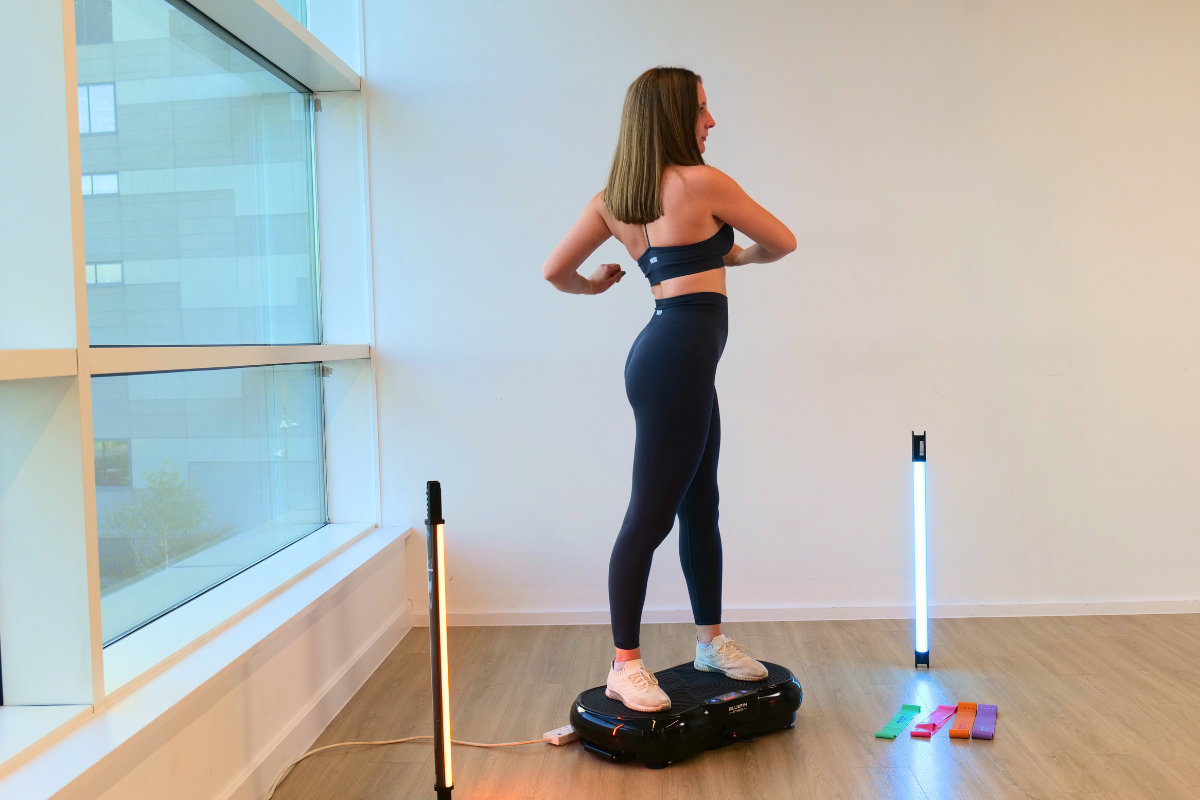
Owning the best vibration plate is only the starting point, how you use it determines your results. This guide shares seven practical, exercise-science-backed strategies to help you maximise every session, from optimising frequency settings to pairing vibration training with targeted exercises for better muscle tone, circulation, and recovery.
Vibration plates have become one of the most talked-about pieces of home fitness equipment in the UK and EU, and for good reason. Whether you're working toward weight management, improved muscle tone, better circulation, or faster recovery, a quality vibration plate can support a wide range of fitness goals.
Many people switch on their plate, stand still for ten minutes, and wonder why results feel slow. The real gains come from pairing smart strategies with consistent effort. From choosing the right frequency settings to stacking vibration training with targeted exercises, there's a whole science to getting the most from your machine.
This guide breaks down seven proven strategies to help you train smarter, not harder. Whether you're brand new to vibration training or looking to level up your existing routine, each approach is practical, grounded in exercise science principles, and designed to work with modern vibration plates like Bluefin Fitness's Ultra SLIM and 4D Triple Motor models. Ready to stop guessing and start progressing? Let's get into it.

1. Match Your Frequency Settings to Your Fitness Goal
The Challenge It Solves
Most people pick a frequency, stick with it forever, and never experience the full range of what their plate can do. The problem is that different Hz ranges produce different physiological effects. Training for muscle activation requires a very different setting than training for relaxation or circulation support. Without understanding this distinction, you're essentially leaving results on the table every single session.
The Strategy Explained
Whole-body vibration (WBV) research generally supports the idea that lower frequency ranges tend to be associated with relaxation, gentle circulation support, and recovery, while higher frequency ranges are more commonly linked to muscle activation and strength stimulus. Think of it like gears on a bike: the right gear for the terrain makes all the difference.
On a plate like the Bluefin Fitness 4D Triple Motor, you have access to a wide frequency range that lets you precisely target different outcomes within a single session. The key is intentionality. Before you step on, ask yourself: what is this session for? The answer should determine your starting frequency.
Implementation Steps
1. Define your session goal before you begin: muscle activation, recovery, or circulation support.
2. Consult your plate's manual or the Bluefin Fitness FAQs page for recommended frequency ranges aligned with specific outcomes.
3. Start at the lower end of your target range for the first two minutes to warm up the muscles before increasing intensity.
4. Track which settings produce the best feel and response in your body, and build a personal frequency map over time.
Pro Tips
Don't just chase the highest frequency setting thinking it means better results. Recovery sessions often perform best at gentler, lower settings. Experiment with amplitude alongside frequency: higher amplitude increases the physical demand on stabilising muscles, so pair it with active exercises rather than passive standing for maximum effect.
2. Build a Progressive Training Plan Instead of Random Sessions
The Challenge It Solves
Sporadic, unstructured training is one of the most common reasons people plateau or lose motivation. Jumping on your plate whenever you feel like it, at random durations and intensities, doesn't give your body the consistent stimulus it needs to adapt and improve. Progression is the engine of fitness results, and vibration training is no different.
The Strategy Explained
A structured progression plan means deliberately increasing the challenge over weeks: longer sessions, higher frequencies, more complex exercises, or reduced rest periods. Beginners might start with two or three sessions per week at ten to fifteen minutes each. Over four to six weeks, that might build to four sessions at twenty to twenty-five minutes, with active exercises layered in.
Think of it like a beginner running programme. You wouldn't sprint a 5K on day one. The same logic applies here. Gradual overload lets your neuromuscular system, joints, and cardiovascular fitness adapt safely and sustainably.
Implementation Steps
1. Begin with two to three sessions per week, keeping each session to ten to fifteen minutes at a comfortable frequency.
2. After two weeks, add five minutes per session or introduce one additional weekly session.
3. At the four-week mark, begin incorporating active exercises (covered in Strategy 3) to increase training stimulus.
4. Reassess every four weeks and adjust duration, frequency settings, or exercise complexity based on how your body is responding.
Pro Tips
Write your plan down or use a simple fitness journal. Tracking your sessions makes it far easier to spot patterns, celebrate progress, and stay accountable. If you're unsure where to start, the Bluefin Fitness quiz can help match a starting routine to your current fitness level and goals.
3. Layer Targeted Exercises on Top of Passive Standing
The Challenge It Solves
Passive standing on a vibration plate has its place, particularly for beginners and recovery sessions. But if active training and body composition change are your goals, standing still will only take you so far. The vibration stimulus amplifies the effect of exercises performed on the plate, making movements like squats, lunges, and push-up holds significantly more demanding than their floor-based equivalents.
The Strategy Explained
When you perform an exercise on a vibrating surface, your stabilising muscles have to work overtime to maintain position and form. This recruits more muscle fibres, increases neuromuscular activation, and elevates the metabolic demand of movements you may already find straightforward on solid ground.
Squats on a vibration plate, for example, engage the quads, glutes, and core simultaneously while the plate adds an instability challenge. Push-up holds on the plate intensify shoulder and core engagement. Even a basic plank becomes considerably more demanding when the surface beneath you is in constant motion.
Implementation Steps
1. Begin each session with two to three minutes of passive standing to let your body adapt to the vibration stimulus.
2. Introduce bodyweight squats: feet shoulder-width apart, lowering slowly and holding the bottom position for two to three seconds.
3. Progress to lunges, calf raises, or hip hinges depending on your target muscle groups.
4. Add upper body holds like push-up positions or tricep dips using the plate edge once you're comfortable with lower body movements.
Pro Tips
Keep your knees soft and never locked during any standing exercise on the plate. Good form matters more than duration: ten focused squats with proper alignment outperform thirty sloppy repetitions every time. Visit the Bluefin Fitness FAQs for exercise guidance specific to your plate model.
4. Use Your Vibration Plate for Recovery, Not Just Training
The Challenge It Solves
Many people view their vibration plate purely as a training device and pack it away between workout sessions. This leaves a significant benefit untapped. Low-frequency vibration has been used in physiotherapy and sports recovery settings for its potential to support muscle relaxation, reduce post-exercise stiffness, and encourage circulation. Treating your plate as a recovery tool can make your overall training programme more sustainable and effective.
The Strategy Explained
Post-workout recovery sessions on a vibration plate typically use lower frequency settings and shorter durations than training sessions. The goal shifts from stimulation to restoration: encouraging blood flow to worked muscles, easing tension, and supporting flexibility. Many sports coaches and physiotherapists recommend gentle vibration as part of a cool-down protocol for exactly this reason.
The Bluefin Fitness Ultra SLIM, with its UK-designed silent-drive motor technology, is particularly well-suited to quiet, low-intensity recovery sessions. You can use it in the evening without disturbing anyone else in the household, making consistent recovery practice genuinely practical.
Implementation Steps
1. After a training session, allow your heart rate to settle before stepping onto the plate.
2. Set the frequency to a lower, gentler setting than you used during your workout.
3. Stand passively or perform gentle stretches on the plate for five to ten minutes.
4. Focus on areas that feel tightest: calves, hamstrings, and lower back respond particularly well to vibration-assisted stretching.
Pro Tips
Vibration-assisted stretching can be more effective than static stretching alone because the vibration helps muscles relax into a deeper range of motion. Hold each stretch for twenty to thirty seconds rather than bouncing, and breathe slowly throughout. This recovery approach can also work well on rest days as a gentle movement session.

5. Choose the Right Plate Type for Your Body and Goals
The Challenge It Solves
Not all vibration plates are built the same, and choosing the wrong type for your specific goals is a surprisingly common mistake. Oscillating plates move differently from linear plates, and multi-motor platforms like 4D Triple Motor models offer a different training stimulus again. Without understanding these differences, you might invest in a plate that doesn't align with what you're actually trying to achieve.
The Strategy Explained
Oscillating plates pivot side to side in a seesaw motion, alternately engaging each side of the body. This makes them popular for balance training and lower-body activation. Linear plates move up and down in a vertical motion, delivering a more uniform whole-body stimulus. The Bluefin Fitness 4D Triple Motor platform combines oscillating, linear, and pulsation movements simultaneously, creating a more complex and comprehensive training stimulus than single-motor alternatives.
For users focused on muscle tone, balance, and general fitness, an oscillating plate is often a solid starting point. For those who want a more advanced, multi-dimensional training experience, a 4D Triple Motor platform offers considerably more versatility across training and recovery goals.
Implementation Steps
1. Clarify your primary goal: general fitness, muscle activation, recovery support, or a combination.
2. Consider your space and lifestyle: the Ultra SLIM model is ideal for those who want a compact, quiet option for home use.
3. Use the Bluefin Fitness Which Plate guide to compare models side by side based on your needs.
4. Take the personalised quiz if you want a recommendation tailored specifically to your fitness profile.
6. Time Your Sessions Strategically Throughout the Day
The Challenge It Solves
When you train matters almost as much as how you train. Many people default to using their vibration plate whenever it's convenient, without considering how session timing interacts with their body's natural rhythms. A more strategic approach to timing can help you get more from each session and support better overall wellbeing.
The Strategy Explained
Morning vibration sessions can be a powerful way to wake up the body, support circulation, and build energy for the day ahead. A short, moderate-intensity session in the morning acts as a physical primer, engaging the muscles and nervous system before the demands of the day kick in.
Evening sessions, on the other hand, are better suited to lower intensity and recovery-focused work. Using your plate at a gentle setting in the evening can help ease muscle tension accumulated during the day and support the physical wind-down process before sleep. The key is matching the session type to the time of day rather than treating all sessions as interchangeable.
Implementation Steps
1. For morning sessions: keep frequency moderate to high, use active exercises, and aim for ten to twenty minutes to energise without exhausting.
2. For evening sessions: use lower frequency settings, prioritise passive standing and gentle stretching, and limit sessions to ten to fifteen minutes.
3. Avoid high-intensity vibration training within ninety minutes of bedtime, as elevated heart rate and nervous system stimulation can interfere with sleep onset.
4. Experiment with lunchtime sessions if mornings and evenings don't suit your schedule: a brief midday session can support afternoon energy and focus.
Pro Tips
The silent-drive motor technology on Bluefin Fitness plates makes early morning or late evening sessions genuinely practical in a shared home. You won't be waking up the household with a noisy machine, which removes one of the biggest barriers to consistent session timing. Consistency across the week matters more than finding the "perfect" time slot, so choose a time you can realistically maintain.
7. Combine Vibration Training with Complementary Lifestyle Habits
The Challenge It Solves
Even the best vibration plate in the world can't compensate for poor sleep, chronic dehydration, or a diet that doesn't support your fitness goals. Many people treat their plate as a standalone solution and then feel frustrated when results don't match expectations. Vibration training works best as part of a broader, well-supported lifestyle rather than in isolation.
The Strategy Explained
Hydration is particularly relevant for vibration training. Whole-body vibration is thought to support lymphatic circulation, and being well-hydrated helps the body make the most of this effect. Drinking water before and after sessions is a simple habit that supports your body's recovery and circulatory processes.
Nutrition timing also plays a role. Training on a completely empty stomach isn't ideal for most people, but training immediately after a heavy meal is equally uncomfortable on a vibration plate. A light snack thirty to sixty minutes before a session gives you energy without digestive discomfort. Post-session nutrition, particularly adequate protein intake, supports muscle recovery and adaptation over time.
Sleep quality underpins all of this. Recovery happens during sleep, and without adequate rest, even the most structured vibration training programme will deliver diminishing returns. Prioritising seven to nine hours of quality sleep is one of the most powerful things you can do to amplify your training results.
Implementation Steps
1. Drink at least one glass of water thirty minutes before each vibration plate session.
2. Eat a light, easily digestible snack if training within two hours of your last meal.
3. Include a source of protein in your post-session meal or snack to support muscle repair.
4. Protect your sleep window by avoiding high-intensity sessions close to bedtime, as outlined in Strategy 6.
Pro Tips
Think of your vibration plate as one pillar of your fitness lifestyle, not the entire structure. When you combine consistent plate sessions with good hydration, smart nutrition, and quality sleep, the cumulative effect is considerably greater than any single habit on its own. Small, sustainable improvements across all three areas will compound into meaningful results over weeks and months.

Putting It All Together
Getting the most from the best vibration plate isn't about training harder: it's about training smarter. The seven strategies above give you a clear, practical roadmap to follow at whatever stage of your fitness journey you're at right now.
Start with one or two strategies rather than trying to implement everything at once. Dialling in your frequency settings and building a basic progressive plan are the two highest-leverage starting points for most people. Once those feel natural, layer in active exercises, recovery sessions, and lifestyle habits to compound your results over time.
If you're unsure which Bluefin Fitness plate suits your goals, the Which Plate guide is a great place to start, or take the quick quiz to get a personalised recommendation in minutes. Have questions along the way? The Bluefin Fitness FAQs and contact page are always there to help.
Your vibration plate is one of the most versatile tools in home fitness, and now you have the strategies to use it to its full potential. Learn more about our services and explore the full Bluefin Fitness range to find the plate that fits your lifestyle.
Share:
What Is a Vibration Plate? The Complete Guide to How They Work and Why They're Worth It
7 Proven Strategies to Boost Circulation with a Vibration Plate